Welcome back for yet another edition of my Conversation with a Gaming Innovator series of interviews! This time we're talking with the lovely and talented Chad Hoverter, sculptor of all of the miniatures you'll find in the new Plaid Hat Games' Dungeon Run. These things are magnificent, and I just had to talk to Chad about his experiences with becoming a paid-gig sculptor.
All of the images below are the pre-production models for Dungeon Run, which Chad crafted, and you can see that they look amazing. Without further delay, here's the conversation with Chad, a true gaming innovator:
SFC: Chad, I’ve known you for a couple of years now and I’ve been amazed by your seemingly limitless talent and passion when it comes to sculpture. While many people have only seen the recent Dungeon Run stuff, because of our relationship I’ve seen some of your other stuff and I’ve always been thrilled to see what you’ve been cooking up. So how did you start doing miniature sculpture?
CH: I've been fiddling with miniatures to one degree or another since about '95 or so, when I traded all my Magic cards for a Tyranid army. Painting armies led to customization led to converting, etc. Eventually I was introduced to a temperamental substance called Green Stuff which changed everything. After my most ambitious conversions, the Green Scar and Heroscape Hive you may remember, I thought I should try my hand at sculpting a entire figure. I tried it and loved it.
SFC: Are you, like Eric Carter, just a naturally talented guy or did you go to an art school or something?
CH: I've always been into art starting in high school. I began a Fine Art degree and then switched to Architecture, yeah, no idea why, I was young and dumb and .... well, you know the rest. I was a horrible student, dropped out to enter the work force as a regular schlub and didn't do much more than sketch, badly, for many years.
In recent years I have tried to focus my creative energies and concentrate on finishing things I start, and my artistic ventures have since been much more satisfying. I still have a lot to learn about art and sculpting but I'm getting there, I hope. Many are mystified by artistic talent, however, I believe it is learned and not natural; anyone can do it, given the desire and proper training.
SFC: I have to disagree with you there. I can do design and layout on a pretty good level, and I can paint with the best of them, but when it comes to illustration I end up looking like a monkey trying to hump a football. I think people were given gifts by God, genetics, whatever you want to call it, and some people are innately talented. The learned part is whether they choose to develop them. That being said, I'd call you the real McCoy. My all-time favorites of yours were either the Rush n' Crush cars you made or that Hulk Heroscape Custom. Those were some of the coolest things ever!
Before I get into Dungeon Run, your latest creation, let me ask about your gaming passions. I remember how you were so giddy about “The Adventurers” at GenCon…it was infectious, and then you taught me Dominion that same trip! When and how did you get into gaming, and what kind of games really excite you?
CH: Magic was my entry into gaming. I was really bad at it and that was back when you played for ante! Holy moly I lost so many good cards! It probably would have turned me off to gaming if I hadnt discovered 40K as I mentioned above. All that was in '95 or so when I was a young' un.
I like games that are heavy in story and/or theme. I love card games like Dominion and Summoner Wars that are elegantly simple and yet hold a level of depth that is always engaging and fun - every game different. I love euro games like Puerto Rico, Carson City, Cyclades and La Havre. I love miniature games as complex as Space Hulk or Decent and as simple as Drakon, and I simply cannot wait to get my hands on a copy of Dungeon Run. Yeah - I know I sculpted the miniatures, but beyond that, the game is tons of fun - literally tons! Mostly, as I get older, what satisfies me the most about gaming is having a great time with friends and family.
SFC: Yes, I am aware of your love for Dominion…if you recall, you were the one who taught me the game! In fact, one of the most fun games we ever played together was The Adventurers back at Gencon last year. So on that note, what games have you been playing of late? Warhammer Quest, perhaps?
CH: Hmm no, no Warhammer Quest, haven't played that in many years, unfortunately. Also unfortunately, I don't really have a regular gaming group or time, I'm lucky to get in a few games with friends once a month or so. My saving grace is my iPad, I am enjoying all kinds of games right now. Disc Drivin', Hunters, Tactical Soldier, Shadow Era, and the incredibly immersive Superbrothers: Sword & Sorcery. The last time I was able to get together with some friends we had several very fun games of Shadow Hunters and Nuns on the Run. Really looking forward to GenCon and some serious game time!
SFC: Me too, man. It’s going to be epic! So, let me ask you this, since I know people are looking forward to Dungeon Run, what’s the creative process like when you’re making minis specifically for a game that’s been designed? Did Colby and Bistro give you broad brushstroke concepts on the miniatures, or did they give you more precise specifications? What was it like working on the project?
CH: Plaid Hat has some really talented concept artists that they can tap and they are the true creativity behind the look of the characters. Basically Colby gives me a concept drawing/painting and it is my job to translate that into 3d somehow. I'm relatively new as a miniature sculptor and this was certainly a huge challenge. Thankfully, I had a good bit of mentoring from several of the regular sculptors from Reaper miniatures.
Working this project was a bit of an uphill climb because I don't sculpt full time (yet), my regular job kept getting in the way with overtime and long weekends. So I found myself getting up at 3am to sculpt, then work at 5:30 and then back at my sculpting desk by 3pm, bed by 9:30 and do it all over again. Thank goodness I have an understanding family! On top of it all I had to redo 3 entire miniatures because of scale issues due to my inexperience. But I think in the end I was able to fix things satisfactorily.
SFC: From what I’ve seen, your inexperience sure as hell doesn’t show. They look top shelf, all the way. So what’s next for you, Chad? What have you got on tap for the near or long term?
CH: Well I am currently working on a couple of audition pieces for a couple of big miniature companies. I also have several private commissions in the works. Basically I am just going to keep sculpting as much as I can until I get enough work to quit my day job and sculpt full time. I really have no idea when that will be but hopefully sooner than later.
There certainly are a lot of miniature companies out there and once Dungeon Run hits the shelves I plan to start hitting them all up for work!
SFC: Well that’s kind of why you’re here! I’ve seen what you can do and I’d put you up against just about anyone on the market, from a Pepsi Challenge perspective, any day on the week. I do these interviews not only for my readers’ informational purposes, but also so that people I believe in and feel have a tremendous amount of underutilized talent may get a look by someone who needs a designer, artist, or in your case, amazing sculptor. Call it paying it forward or whatever, but my overdeveloped sense of justice simply forces me to do what I can to help who I can, when I can.
This seems like a good spot to call this a wrap, and thank you so much for your time. Wait, I lied. One more question. Where are you going to be at Gencon? Maybe doing autographs at the Plaid Hat booth with Mr. Bistro or something?
CH: I will definitely be around the Plaid Hat booth although not in any official capacity. I'll be running around trying to drum up business. And when I'm not doing that I hope to be playing some game or other, Summoner Wars perhaps.
Thanks, Pete!
SFC: The honor is mine. It's great to see an incredibly talented sculptor finally being recognized and watching a friend's dreams become a reality. It really couldn't have happened to a nicer guy, and the Circus staff wishes you nothing but good luck now and in the future.
Just to give some reference, Chad's been up to all kinds of things over the years as we alluded to, such as his comment about modding a Heroscape Marro Hive to look absolutely amazing...
http://www.youtube.com/watch?v=-Ucei0hkjdA
...as well as kitbashing a Marvelscape Hulk to be Gladiator Hulk...
http://www.heroscapers.com/community/showpost.php?p=887091&postcount=61
Want to read more about Dungeon Run? How about a rulebook, chief! See here: http://www.summonerwars.com/DungeonRun-Rulebook.pdf
Well, it's time again for another of my jaunts into proper journalism, and this week we have another game designing, illustrating, and graphic designing phenomenon, the great Eric J. Carter. Who, you ask, is this? This is one of the best illustrators out there right now, that's who. He's worked for Tasty Minstrel on their upcoming Eminent Domain project as well as on a little, obscure game you may not have heard of: Dominion. Let's get the show on the road!
SFC: Eric, thanks for taking the time to chat with the likes of the Superfly Circus today! Let's start out with an easy question to get warmed up. How did you get involved with Dominion? What was it like working with one of the biggest properties out there?
EJC: I saw that Dominion, like Magic, used several different artists, so I hoped that Rio Grande Games would be open to trying out new people . I gathered up my courage and sent off an email to Jay at RGG offering to do a card for a future expansion. Jay's positive response was exciting , and he said he'd contact me after the holidays. New Year's came and went, as well as Valentine's Day, St. Patrick's Day and Easter. Just when I had given up hope I got an email from Jay that May giving me the assignment to do the Talisman card for Prosperity.
I spent 25 hours working on that image, which other card artists will recognize as a non-profitable amount of time, but I wanted my first professional fantasy art job to be perfect. Jay had no changes for either my rough sketch or final color work and paid quite promptly. According to the NDA I was allowed to say that I had a card in the game, but I just couldn't show the image or tell anyone what it was called. Besides that, I decided not to tell anyone about it, anyway due to the universe being out to get me.
I envisioned something going wrong during the process. However, I had this vision of my friends finding out 'accidentally,' so I kept mum about it completely all the way through GenCon, where my friends who were in attendance missed their chance to buy a copy.
Now at the time I kept one thought in my head to kind of mediate my excitement over being in my favorite game. I remember Donald X. Vaccarino sharing that they had accidentally commissioned two images for the Market card, so I kept telling myself that being included wasn't guaranteed. Yes, I had been thanked for my work and yes, I had cashed the check, but a part of me kept saying "something could still go wrong." So that night when I saw the spoiler images in Board Game Geek and my art was in there, I was beyond ecstatic. From that point on my self-doubts were gone and I was ready to embrace a dream I had given up years ago.
SFC: Wow, that's a "I love it when a plan comes together" series of events, huh? I'm glad to see that perseverance paid off. Incidentally, the art that you did was amazing, and I can see why Tasty Minstrel wanted you on the team. The art for Eminent Domain is pretty spectacular. How did you hook up with Michael at Tasty Minstrel?
EJC: Not long after Prosperity was out I saw the promotion going on for another deckbuilding game, Eminent Domain. I and a couple of game buddies went in together on a Kickstarter sponsorship. The Tasty Minstrel people have been very open about the game's creation and pre-production through their site and on BGG, and it was in one of those Forum discussions back in November that I mentioned at the end of my post "BTW, need any artwork?" It wasn't but a few minutes later that I heard from them by email.


EJC: I've got a sci-fi cover commission to work on during the next few weeks. It's not my first book cover, but it is my first genre one, so I'm excited about that. Some logo work is waiting on a committee to give me the go-ahead... I also have a long-standing project that's nearing the finish line. A few years ago I was contacted by someone who had an idea for a series of educational children's books and needed an illustrator. I've been collaborating with him on it since then. Each book is 40 pages and there are 11 books, so we had a huge cast of characters to design and each book went through 2 full mockups before I began creating the final artwork. We've got 9 of the 11 books in a finished form and I'm halfway through the tenth. I expect to be done with the last book by the end of the summer, then by the end of the year we'll have finished any modifications the previous books need.
Hopefully sometime in 2012 that project will be available for purchase to school districts nationwide. Between now and then I want to be in contact with some publishing companies and use those books as a way of securing other children's book projects. And, yes, I have ideas for my own children's books as well. I really wish the scientific community would get that immortality pill in production because there is so much stuff I want to do before I start decomposing.
SFC: So it sounds like you've got all kinds of irons in the fire! I can feel your pain as getting older makes you look back and think about how you might've done things differently. I'm quite honestly pretty satisfied with what I've done, aside from the one time I caught the clap, but I've always been ruled by my own moral "bushido" code and have never deviated, so I really have very, very few regrets. I'm just a little too impulsive sometimes, but hell, I figure that goes in the plus section!
So now onto my final question: what kind of games do you like, and how did you get mixed up in this crazy world of hobby gaming?
EJC: In college I played Talisman a lot. That was my first cool board game purchase. Then Magic: The Gathering came out - that was great fun for a few years. I bought and played that game all the way up to the Tempest set. It was years later that I saw Heroscape on a store shelf... that lovely little addiction threw me into the deep end of the gaming pool. I found myself on Heroscapers.com on a daily basis, then onto Boardgamegeek.com... and suddenly I was buying game after game after game.
I went from one half-shelf of games to three full bookcases. The gateways came first - Carcassonne and Ticket to Ride. Then Last Night on Earth and Zooloretto. Now I have Dominion and all of its expansions, Race for the Galaxy, four different train games, Galactic Emperor (which I bought because Twilight Imperium is too damn long), the entire Thunderstone collection, both Ravenloft and Ashardalon, and a very gorgeous Hilinski Crokinole board. I'm looking forward to more Dominion releases, Battleship Galaxies, and, of course, Eminent Domain.
SFC: Don't get me started on Crokinole boards...or for that matter, Heroscape! One last question, though, that I forgot to ask and I wanted to mention. I heard you just hosted a Con out in Kansas, "EricCon", and was wondering how hard that was to put together, and how it worked out?
EJC: That was more of a game day/party than a con. For my 40th my wife rented a hotel's meeting room. It was big enough to hold 4-6 folding tables and some snacks. I had a dozen friends show up and we played from noon Saturday until early in the morning Sunday. We played Crokinole, Dominion, Innovation, Andromeda, Crokinole, Ashardalon, Tumblin' Dice, Crokinole (on my sweet, _sweet_ Hilinski board), and ended with a few rounds of Werewolf, during which we were hushed by the hotel clerk around 3am for being _unruly_. I loved every minute of it.
SFC: Yeah, now I wish I'd have made it out, man. Sounds like it was a blast, and it would not be the first time I was asked to leave by a hotel employee. Thanks again for graciously putting up with me and allowing The Circus some insight into the mind of a genius. You're a hell of an illustrator, and I wish you every success both personally and profesionally.
You can see more of Eric's body of work at his website, http://www.ericjcarter.com/.
David Muta is the president of the upstart Board Game Exchange (www.boardgameexchange.com) company, which offers something we, as boardgamers, have never had: the opportunity to rent games in order to see if they're good enough to buy. Asshats like myself get plenty of games on the opinion of others, the look of a game, and the theme, but many times I've been disappointed and have had to spend $15.00 to ship it to someone else to trade for something I actually might like, so the way I see it, this is a great program.
I've heard OCD collectors that have 1200+ games in their collection decry this concept as a bad idea, but realistically, who the hell actually has the room, money, and desire to collect everything? Seriously...if it wasn't a good model, companies like Gamefly would never have adopted it. I'm incredibly pleased that David has started the company, especially as a hard-core gamer who doesn't have 50 bones a month to spend on games that I may not even like.
So, without further delay, let's get to the interview...
SFC: David, welcome to the Circus! It's been about six months since I first heard of your program, and a really good friend of mine is a subscriber. He's raved about it since he runs a game group and he always gets to try newer stuff for his group, which was the main reason I wanted to talk with you. What the hell gave you this idea, and why did you think there'd be a market for it?
DM: I appreciate your enthusiasm about the company. I am glad your friend enjoys the service, we have worked very hard and love to hear that we are keeping our customers happy.
The reason I came up with the idea is that I had always really been a video gamer; a friend of mine told me about a board game; "Ticket to Ride", and being a video gamer, I was skeptical about board games anyway. I had a really hard time finding the game, and found it at a small local game shop in Bloomington, Indiana where I went to college.
The price of the game was about 55 dollars at the time, and I was hesitant to buy it at first. I purchased it, really loved the game and played it for a few weeks; then like most board gamers, wanted to immediately play more and more games.
I got on Board Game Geek, at the time, Agricola was the #1 game rated on their website. So I paid $65 for it. Sure enough, I enjoyed it; I then wanted to keep buying more, and I was spending too much money on the games. I looked all over the internet for places to rent games and really didn't see anywhere. I did a great deal of research and spoke to a friend / now partner and the idea just seemed like a good one, we were on the same page. We both have had previous business experience and the idea really fell into place after many many talks.
People have asked how long we will go or what happens if... we have had such an overwhelming response, and the customers we do have and people that have praised the idea really has been eye-opening.
We are excited to see what the future brings to the customers of Board Game eXchange. BGX plans on being around for quite sometime.
SFC: With my reader base, you may not want to admit that you love Ticket To Ride and Agricola so much; they may storm your warehouse and pelt your employees with Heroscape dice! Seriously, though, it's hard for me not to be excited. This is a great idea. So, give me the short version of how it works if one of my readers is thinking that this might be for them?
DM:I like all sorts of games, those are just the first 2 that really got me into the scene. This really works the same as it sounds. Basically, you sign up for one of our subscription packages:
Bridge (2 Months) : (More for people that want to test our subscription out, or are new to gaming ) - this is a subscription we added for smaller games that we can ship in flat rate envelopes only, and there's over 70 games available for this subscription level.
Silver: 6 Months if you really want to get into trying many different board games and want the option to play and purchase more expensive games.
Gold: 12 Months: For members that really want to have access to many rare games and we also include full games / expansion on there such as "Dominion + All Expansions" and Thunderstone + All Expansions
You pay with your credit card and add the requested information such as "Address, Telephone #, and name" , then you add 5 or more games to your "Request List", then email us what order in which you would like to receive those games. Within 24 hours, we ship the top 2 games from your list to your door step Priority mail so you get them quick.
It really is that simple.
We try to add about 20 or so titles a month to the list and we are slowly growing the Gold Level Only Section, but some of those games are pretty expensive.
SFC: Ok, so it seems pretty simple. So, what's the difference between the selections? What makes Gold and Silver what they are? What are some examples of what kind of games would be in Gold, but not in Silver? I understand that you get game expansions at Gold level, but do you have older games, like Warhammer Quest or Merchant of Venus at that level?
DM: Gold is generally much rarer games and out of print games. We have Antiquity on there, as well as, Civilization / advanced civilization, Evo, Java, Star Wars Epic Duels, Hero Quest and more. We generally are trying to add one or 2 titles a month to this category.
Gold level members usually get free games that we have gotten from publishers, as well as if they have games on their list that other customers do, they get priority for the games that are the same. Gold level is definitely the best option for customers wanting to get their full money's worth for their Board Game eXchange subscription.
SFC: Okay, so let's look at that, then. The Gold subscription is $27.00 a month, for an annual cost of about $324.00. That's a lot of scratch for people, and I can see how some of your detractors would rather spend that money on buying ten or so games that cost about $30.00 each. It appears from your website that Gold level subscribers can try as many games as they want, which I assume means that they can ship back games and get new ones any time they want, right? If that's the case, how many games a month or year do you believe is possible for an average person anywhere in the United States to rent?
DM: Basically the package works like this: If you are a gold level subscriber, you get 2 games at a time on your request list. Usually there is at least one more, sometimes more than that depending on how many games donated by partners we have at any given time.
They arrive at your doorstep and you play them for as long as you would like, then you have the option to buy the game / games at a preferred rate which is usually about 7-8 dollars less than your average online retailer. As the games become played more, it may even be a better discount than that, but that is a good rule to go with.
You ship the games back with the included prepaid postage, then your next couple games come to you.
This service is much better than buying 10 or so games for many reasons, but the number one reason is the fact that there are plenty of games that really just not worth the 30 - 50 dollars you spend on it. They lack the replay value necessary to constitute a 50+ dollar price tag. I look at it like this, the 20 / 50 / 30 theory. 20% of the games you buy you wont like and will trade, 50% of the games you buy you will like and play for a month or so, then it will hit the shelf, 25-30% of the games you buy you will greatly enjoy, keep and play frequently.
In each of these cases instead of trying 10ish games for your $300 dollars. At the minimum, you'll get to try 24 games with our gold level subscription. This being said. Using the 20 / 50 / 30 theory. instead of 2 / 5 / 3 games you buy and dislike, hold onto or shelf, really like. You will get to try and review at least 24 games. on average, 5 of those you wont like immediately, 11 you will kind of like but be happy you didnt purchase because it may not have had the replayability you were looking for, and 8 you would be happy you played and purchase from us or another retailer.
I know this sounds kind of complicated, but you can see what I am saying by renting and trying out the games. It really makes sense and the 300 dollars a year sounds steep, but to play the extra 14 games or more you get to try for the price, the deal really makes sense for anyone that really likes to delve into and try a great deal of games. Even reviewers have signed on because they see the value of the service. and even if you buy the 10 games from us that you would have purchased anyway. You get the games you wanted anyway after trying them for about 8 dollars less each on average and they will all get the replay value you were going to purchase them for in the beginning anyway.
SFC: Hell, I can look at my game shelf and see at least 10 games I wish I hadn't ever purchased and nobody really seems to want to buy or trade from me. Let me ask you this, to continue that train of thought: I understand you take games on trade, and the trade amount is applied as a credit to the account. Can I compound that trade credit towards a purchase of a game from you at the discounted price? It seems to me that it's better than doing a BGG trade because if you give me a credit on 2 games I trade you, I can then get one back from you on a purchase basis without having to spend any money on shipping. Is that accurate, or does the person trading games to you have to pay shipping?
DM: As of now, we accept trades of games for months of credit to our company. This is a great deal as customers can get free months to play all the new games they want to while gettting rid of their games collecting dust. Also, then other customers can play those games that were traded.
SFC: Fair enough. I want to talk about discounts on buying games, as you mentioned earlier. You said that if people wanted to buy a game that they want to, they can do so at a discount. Can you quantify that point, maybe with an example of a game that you have that I may want to buy, and can you then elaborate on how that works? If I'm a subscriber yet I am a collector as well, would this be a good deal because I can save money on boardgames?
DM: People have asked why I dont advertise game prices. The reason being, they fluctuate. Basically, if the game has only been played once, we usually sell the game at a price point about 7-8 dollars lower than anywhere else online.. sometimes that discount is much more, sometimes a hair less.. and you never will pay shipping. If a game has been played a great deal more, the price can be much lower. It really just depends.
I sold a copy of Dominion and an expansion to a customer that hadnt been played before him for $26.50 each / dominion and expansion. But some games I have a harder time reaching that low threshold. It really matters how many times it has been played and what game it is. We send a "Preferred price sheet" with each game with a purchase price.
We have had customers buy a great deal of games from us. I dont know if it is because our prices are very good, or that it is just so convenient for them. But both are great benefits of our service. After the game is purchased, we ship the empty box with the next order and that is all included in the subscription price. Customers never have to pay any shipping for any games they purchased.
SFC: I think that because you have a different model than the “Troll and Toads” of the world who make their profit solely from online sales, you have the opportunity to leverage your subscription-based profits against the competition and really whip their asses. I mean, with subscription-based access to discounts in unison with having what amounts to used game sales and a robust trading program, you could be a huge player in the market. Don’t you think that if you were to publish your prices in a flexible format, for instance stating that a game is between two price points, based on volume of rentals, that you might attract people to subscribe based not just on the service, but for access to your “Sam’s Club” program? Or just get more traffic which could produce subsidies to your cost structure in the form of advertising sales on your site?
DM: We have had many customers and potential customers ask us about our sale prices, and your questions sparked a great deal of discussion amongst our partners. We are all about fulfilling customer demands, and our customers' feedback has sparked a number of improvements to the service and the website...some of which will be announced in March 2011.
Up until recently, we didn't have any good plan of action of listing our Preferred Members' Pricing, but we have come up with a solution based on a tiered pricing system. If you look at our website now, we have begun to add price ranges for games, which our Subscribers will find favorable as compared to other online retailers.
Because we are selling games "slightly used" and we have worked out great deals with publishers and distributors. We are able to drop the prices significantly as compared to competing retailers. For example, we are going to be offering Dominion in the future for around $23.00 to our subscribers.
Dominion (Slightly Used $23.00 - Very Used $15.00) [B1]
You'll see the "[B1]" behind the title, that also means that you can rent this game as part of our Bridge To Gaming subscription for only $13.99 per month. The Bridge To Gaming subscription is a new subscription level which will be launched in the next week.
SFC: What I really want to ask you about is sustainability. I am having a huge issue figuring out how you guys can make money at this. Some people think that your Gold level, at the $27.00 dollar price point, is a bit high, but I can’t see how you guys can afford to do it even at that. First you have to buy the game, then you have to ship it round trip. Even if you amortize a forty dollar game over 10 shipments, that’s still going to cost you two flat rate boxes and four bucks for the original investment. And that’s based only on one game, one round trip shipment a month. If you do it twice, or with two games twice a month, you’re spending $40.00 a month just on freight to that customer. How the heck do you break even at this price point?
DM: Your question assumes two round trip shipments per month. That is incorrect. we allow customers to get 1 shipment a month which contains at least 2 games, usually more; We use a great deal of flat rate shipping as well as working hard with a shipping consolidator to help reduce the price of shipping the packages all over the country. The logistics of this deal has been quite a large learning curve that we are still really working hard to learn everything we can about reducing shipping costs. Trust me, I would love to give the service away for 12.00 dollars a month, but with the value of some of the games and the cost of shipping the games round trip, it is impossible to go any lower than that for our gold level offering. Antiquity for instance is $270+ Dollars and most of the games we offer retail well over $50 each.
As far as sustainability, we have vitually no overhead, no debt, no monthly fixed costs, nor do we have any drop-dead date by which we must reach a certain level of revenue. We knew the heavy upfront costs of board games was going to be the most expensive part of the company and we were prepared for that and are prepared for that in the future.
As we have expanded our library, people have been renting a great variety of games and we continue to grow our library and try to not get stuck with a great deal of inventory that doesn't move.
It is surprising what games people have rented. I thought many games would have overlap, but we have found the exact opposite--there has been minimal overlap of the games requested between our different customers.
SFC: OK, so it's a once monthly shipment program, so the most a person can actually play in a 12-month window is 24 games. That's still cheaper than buying them, so it's still viable for a person in my position who would look at monthly cash flow for things like this over annualized comparison versus purchasing. Well, let's talk about selection now. The "cult of the new" is a big deal on Boardgamegeek, which is the biggest player in board game media by far, and unless you keep up your catalog, you're going to be in deep shit. I was reading a thread on BGG where a user complained that of maybe the 15 games they wanted to play, you only had 2 of them. What is the driving force behind your catalog, and what guarantees a subscriber that you're going to keep a current list? What is it that moves you to pick up a game for the catalog?
DM: The Driving force behind my catalog is based upon 2 variables. 1 - I have a great deal of customers that have requested games from me, I try to bring in about 90% of what is requested. I also try to keep my "fingers on the pulse" when new games are released and work to get in line for the new games. 2 - My distributors and publishers that I purchase games from work to keep me up to date with the current releases.
The post in question on Board Game Geek, immediately after it was written, I made 5 phone calls and had about 8 of the 15 she that I didn't have were immediately on the way to my warehouse.
If it weren't for our customers, we would not have a business at all, therefore we work hard to keep our customers satisfied. We are continually adding new games to our library, while maintaining our inventory. We have already added well over 100 titles since our launch in September and we try to add games about bi-weekly. Without new games, the business will get stale and the customers paying to try our unique service will be upset. We understand this and work hard to keep the titles fresh and new.
SFC: Let me ask you this, then: Based on your subscribers, what kind of games are being rented? Are they primarily "cult of the new" games that have just been released, or are they primarily older, out of print games that are high up on the "charts" so to speak?
DM: We have had such a splattering of board games I was very shocked. I really thought there were going to be only new board games rented, but we have had customers rent everything from Antiquity, Twilight Imperium, to Apples to Apples and even games like Booktastic.
It seems that all customers are very different than we thought, some games that are popular amongst a great deal of players, such as dominion haven't moved as quickly as some of the more obscure games. At one point, Mystery of the Abbey was our most requested games.
Our service really gives customers a chance to try and play games they normally wouldn't have purchased and I feel our request list from our customers has definitely reflected that. I really thought we would see a great deal of overlap, but the spread has been really even and that has really helped us. Although I say this, whenever we bring in newer and hotter games, they are always rented for at least a few months before they sit for a while.
SFC: Will you ever put a “counter” on your site and a blog/comments area or ratings system up so that subscribers can not only see what their peers are renting, but also read about what they had to say about the games?
DM: As of right now, we have a "review" section:
http://www.boardgameexchange.com/referrals__reviews
This is fairly new, and we have just had a few reviews start coming in.
Yes, I would love to have an online community where customers can come, review games, read what other renters have said about the games, and to see what games are trending. We are pushing ourselves and website designers towards that goal, we have many services we would like to offer our customers; but just launching less than 6 months ago it has been a gradual process and everything we have done takes time and strategic planning. We want to make our service user friendly, while not confusing our customers.
First and foremost we are the nation's first subscription rental service for Board Games. The community aspect of the company is all just a bonus for the great service we offer.
SFC: But there is no counter or anything to indicate what other people are renting? No "hotness" chart or something?
DM: As of right now, there is no "hotness" chart, we have been talking to our designers about this and it could be implemented in the next few months, but as of now, we do not have anything like that.
SFC: Getting back to your business model, I'm curious to know what publishers think about the prospect of you renting their games. Have you gotten any feedback from a publisher?
DM: Absolutely, We have had several publishers that see the tremendous value we offer them by getting games in front of a great deal of players and then can be reviewed by them. Small publishers have loved this, and when we get copies of games; we send them to our customers just as an added game. So this is great for the customers and publishers both.
The customers play more games, try new ones, at no risk to them; who doesnt want to try a few brand new board games.I am currently in talks with several large publishers and we are on the edge of a few deals that could be very beneficial for all parties invloved.
SFC: For my last question, I want to ask you about feedback. And I don't want to hear all the bullshit salesmanship that I would expect, I want an honest answer! Seriously, what are your customers saying?
DM: Our feedback has been exceptional. We have customers that have been so happy and thankful for many reasons, also, we have had a surprising amount of customers that have given us many ideas and we encourage that. Our customers know what they want, and we keep working to improve the service based upon their needs.. If you look at the "testimonials" section on the website, you'll see a great deal of positive feedback we have gotten.
Our customers have helped shape and improve the company to where it is today and where it is going to go in the future. For instance, I just got this yesterday:
Hi. My latest game is on it's way back to you. My top choices from my request list right now are A Castle for All Seasons, Thebes, Cluzzle, and Luna.
Thanks!
Tiffany
p.s. We loved Ambit so much we are buying it from you. :-)
SFC: On that note, I'll we'll call this a wrap, and I do so appreciate you taking the time to meet with me!
DM: No problem, and thanks for the opportunity to talk about the company! If anyone wants more information, please check us out at http://www.boardgameexchange.com/!
Well, Circus fans, I'm still fighting the good fight here, attempting in some small way to expose the great unwashed masses (which is a particularly appropriate statement given my GenCon experiences) to new, interesting people that are behind the scenes in the gaming world. Call it my personal contribution to gaming journalism.
Anyhow, today's interview is with someone that you may not have heard of, but someone that deserves recognition. David is an incredibly talented graphic artist and game designer who has worked with companies such as Grindhouse Games, Stronghold Games, and White Goblin Games on games such as the prolific 'Incursion', the recently reprinted and updated 'Survive!', and the soon to be released horrorfest, 'Dark Darker Darkest'. So, while he may not be a common name, yet, I feel that based on the body of his work, he sure as hell should be.
Based out of Belgium, he's been in the industry for a great many years, but until I ran into him at Fortress: Ameritrash, I didn't know who he was or what he was about. Now that I do, I'm happy to call him a friend and help you, my readers, get to know the guy. That, my friends, is what Conversation With A Gaming Innovator is about: bringing you face-to-face with people who you really need to know about.
Without further delay, let's get to the interview!
SFC: Hey David, welcome to the Circus! First of all, I went to your website, and I was thoroughly impressed with your art...it is, in a word, outstanding. When did you start doing graphic design and how did you get into the field?
DA: Thanks. Glad to enter the Circus for a brief visit.
Well, after I graduated as a painter at the Royal Art academy in Antwerp, the same art school were Van Gogh once attended classes before cutting off his ear, I started working as a junior graphic designer at a company involved in website production. My boss simply told me I had to learn all the tools for graphic design in a month time in order to stand a chance of becoming a member of the team, so I worked day and night to get a grip on any software package that a respectable designer should know how to use.
I worked in the business for 6 years, before I called it quits. I just simply couldn't bear to do another campaign for soft drinks or worse, online banking. At a family gathering one of the uncles brought a copy of 'Risk'. Yes, I know...the devil for most respectable board gamers, but still...I was hooked and at that point my passion for hobby gaming started.
As a kid I had spent many hours creating my own board games; basic variations on roll & move stuff souped up with my obsession for everything macabre, yes...I was a strange kid way back then. This renewed discovery of board games also soon rekindled my interest in designing my own stuff. I was finally able to use all my gathered knowledge of graphic design for something I was truly passionate about. It was great to experiment with the form/function aspect of board game design. Learning how to design iconography that was crystal clear, how you optimally use the space of a board...all the basics a good graphic designer needs in the world of hobby gaming.
I think it was good to have started doing graphic design in a commercial context. After all, it is important to see a board game as a commercial product, despite its obscure nature. For me it is important when I do graphics I communicate both the theme and functions of the game in a way that is understandable for a wide variety of people, both hardcore hobby gamers and casual gamers, without losing character along the way. It's all about balance. I find it a challenge to even make a niche-product about gritty zombie survival look polished and accessible, despite the graphical nature of the subject.
Furthermore I think my experience as a painter also comes in handy, because painting is above all creating mood, and I find it interesting to give all my board game graphics a painterly quality. For example, look at the cover for Rogue Agent. It has a lot of painterly aspects worked into it. I work these days on a digital painting tablet, and it is absolutely a joy. It feels like actually paining and I can achieve detailed stuff in a reasonable amount of time. These days, graphic designers are spoiled. My father, once a graphic designer himself, had to do everything by hand without any way to correct his mistakes. It was a once-chance-to-succeed situation.
No you add layer upon layer, and with a simple click you can correct ot remove an element that doesn't work/look good enough. It feels almost like playing around for fun. But of course, it's better to keep such a thought for myself. Some people in the graphic design business will want to scalp me for saying this, or at least ban me to Canada.
SFC: Ha! I doubt you'll get banned; there are a lot of companies that could use a guy like you. Before I move onto Rogue Agent, which looks absolutely outstanding, let me ask about Stained Steel. I looked at the graphics on your site and they're bloody brilliant. I mean, that's one of the coolest looking games I've ever seen, at least in the Sci-Fi genre. It's awesome. Can you tell me about that?
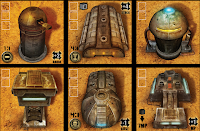
DA: Well, this might be my most ambitious project yet. It's my take on an epic empire building game with all the bells & whistles and then some. The idea for this game came when I got this idea for an innovative action selection system that uses rotating discs that interlock to each other, creating an ever-changing turn system that renders a dynamic game world were a sudden sandstorm could completely mutate a safe action you did a turn before, now transformed in a dangerous endeavor. It perfectly simulates the uncertain aspects of resurrecting an empire in difficult circumstances.

But I will eventually return to this project, and I promise it will be breathtaking. It will be everything you can dream off in an empire building/dudes on a map game.
It has several boards: each player has a personal board were he develops his home base, which is almost a game in itself since every placement of a building matters, and there are mining sites in the center of the table were you move diggers in order to gain valuable material. There is also a black market with fluctuating resource prices were you can buy and sell resources. You can even stock resources in your depot in order to influence the market.
Actually, I think it really combines a lot of elements that could easily stand as a game on its own, but when interlocked creates this involving mix of epic scaled building and manipulating that gives you a true feeling of progression. And in the final turns you could see it all turn into ruins, when your enemies stomp all over your hard work!
SFC: That does sound ambitious! I'd love to see it picked up by someone because from the sound of it, it could be a huge success. I love the dark, decaying look of the art, and now that you've explained the game, it sounds amazing. Now let me move onto another project I noticed on your site. What is Rogue Agent? It looks beautiful, with a dark, "Blade Runner" quality to the art, theme and overall feel of it. What's the story with that?


So basically, the game starts with players trying to gain power in the city by hunting after crime bosses who gradually get more value bounty-wise when the game progresses, confront assassins who roam the streets and neutralizing bombs placed by the crime networks that threaten to blow up districts. Players can also create a network of helpers in locations that protect them and help you gather information. You can even visit the Gambling hall to put money in the slot machines or rob the city bank.
While the game progresses, players will gradually gather more identity cues that can be revealed by others or in true Blade Runner fashion by self-explored. When the endgame triggers a race against the clock starts were one or more androids are up against the human agents, trying to reach enough power to win the game. They will try to destroy several locations in the city holding the android memory banks, while the human players will do anything to stop them.
I'm currently doing some last refinements to the system. I like the fact it always creates a lively experience at the table, creating some storytelling with people getting into character. One of the first sessions I playtested the system was with a group of RPG buffs and it was great to see how they completely jumped into the game world. Right from the start that proved to me this system had potential to be more than just an optimization exercise.

Currently I am developing an optional module that can be added to the basic game, consisting of a small deck of character cards. These are basically tormented Agent bios, with a thematically connected special ability for each of them and a personal mission to score extra power in the game. It gives Rogue Agent that extra bit of RPG feel that is so often overlooked in board games. For me games are all about the creation of stories. I love it when after a session people recall moments in the game that had some momentum. Eurogames just don't seem to be able to generate these.
SFC: Speaking of Panic Station, I've noticed some commentary and interest about that project. It looks amazing, and I love the claustrophobic, tense feel of not knowing whom to trust. What is Panic Station about, in your words?
The idea for Panic Station came after watching a midnight screening of the John Carpenter classic "The Thing". It was my favorite horror film of the past, and despite the fact that some of its visuals are a little outdated, the core of the movie still holds well after all these years: a group of people trapped in a location, confronted with the unknown, with the knowledge you can trust nobody: everyone could be a monster.
I wanted to translate this concept into board game form. A game that creates a high degree of paranoia so that during the final turns nobody trusts anyone, and yet to survive, players need to trust others in order to achieve their mutual goal: destroy the hive that is the root of a parasite infestation that slowly overtakes all characters.
The game uses cards, both for items, character cards and floor plans. As the game progresses the board is formed, a labyrinth of rooms were players can explore, use the terminals to gather information, perform heat-checks of the building to deduct who to trust and who is most possibly infected and gather equipment that will help them to stay alive and destroy the hive.
At the start of the game one player is infected, but he must keep this secret for the rest. This traitor role is subtle and players need to learn the timing to strike at the right time, in order to infect others. The goal with other words of the infected players is to gradually, in an exponential way, infect the rest of the team.
This is done during a blind trade action that always forms a nerve-wrecking moment in the game. Since this is a blind trade (cards face down) only the traders know what is happening. The rest of the players at the table have to carefully watch the behavior of the trading parties in the next turns to partly deduct the presence of the infector.
As if this was not enough challenge-wise, parasites roam the rooms of the base were the game takes place. These are controlled by the game system but if not taken care of could form a serious threat for the players. In order to win, players need to reach the hive room and gather 4 gas refills to load their flamethrower. But these cards are scarce and are also needed to fend off infections during trades, so players need to keep control of their growing paranoia. If they trust nobody, they will fail to keep enough gas refills to destroy the hive.
What I personally love about the game is that it packs a lot of punch and intensity in only a short game time: about 30-40 minutes. Each session is also different, given the modular nature of the board and the fact the core of the game is the psychological warfare between players, rather than the game itself. Each traitor will play the game differently, so more careful, some more reckless, and it will create a different story each time.
I will never forget that first session I did for the game. When you write down rules you are basically writing down something abstract with no certainty it will actually work in practice. But while the first playtest has some small tweaks, it was already apparent from the start the paranoia thing worked as I envisioned it, and possibly even better. By the end of the session everyone was nervously laughing, and the tension was so intense. I almost felt the urge to leave the table to get some relief from it. At that point I knew I was onto something.
I am hoping to also get a small bonus expansion ready for the publisher, possibly to offer as a goodie at Essen. It will add a game system controlled roaming infected guard dog to the base that forms an extra threat for the players.
As if that was needed ;)
SFC: That sounds sinister! I like it! Going back to what you said before, I think that the Eurogame audience isn't looking so much for a story to tell as much as a "Mentat-like" experience where the object is to out-think their opponents where the Ameritrash audience is looking for that storytelling. I play both, and, at least in my experience, the level of interest is far stronger in a game where there are strong characters and a compelling narrative.
I know Panic Station is looking like it’ll be out by Essen 11, but what's going on with the other two? Are we going to see them anytime soon? Is anyone talking to you about publication?
DA: I find it important to take time to let a project mature. It's very tempting to prematurely get it out there and start contacting publishers once you feel the game works, but from experience I learned it’s better to let it rest a few months and give it a fresh look. That way you are able to approach it from a perspective of a gamer, not of a designer, which is a totally different view on things. People often underestimate the time commitment for designing a game.
They write down an idea on a piece of paper during a train ride home, start dabbling with self-cut cardboard tiles and glue spray and they feel they have a game half-ready. The truth is that this first sparkle is only a tiny fraction of the complete process. The real game development starts at the gaming table and will consist of an endless string of revisions and refinements. Sometimes I have to restart from scratch with some mechanics because in practice they just didn't gel with the system, while on paper they look cool.
It’s a painstaking process of trial and error, and you need a perfect playtest team to guide you through. This team should consist of the most critical people possible with a good analytical brain. And believe me, this type of people are rare. And don't forget the constant intoxication of glue spray shortens your life span with roughly 15%.
A publisher once told me that only 1 in 5000 game ideas they get submitted makes it to the shelves. Given the fact only 1 in 1000 game ideas get submitted to a publisher it might be a good idea to only start designing if you’re totally obsessed with it. When I'm working on a project, it is constantly haunting my thoughts. Sometimes I wake up in the middle of the night and have to grab a notepad because the solution for a mechanical problem suddenly struck me. I have lost a lot of sweat, blood and tears over the design table during midnight creative sessions. But when you finally sign a contract...that magical moment just makes up for everything.
But to get back to your original question: I have some companies in mind for both games. Rogue Agent is definitely the first that is going to be submitted.
I think it stands a good chance on the market, because the cyberpunk as a thematic backbone is not over-saturated on the marker (unlike the 5678 auction games set in Egypt) and the game uses a modest set of components despite its grand scale game world. I just love there is a lot of game in a small box. I would describe Rogue Agent as a hybrid, combining the rich theme of true Ameritrash with the focus on a more elegant approach of Eurogames. It's definitely no Carcassonne, but the rules can be explained in a fair timeframe and feel intuitive after a round or two.
SFC: Regarding the process, I know exactly what you mean. I've had a post-apocalyptic game on the shelf for months, and was ready to get it to a publisher...I even had a meeting set up. Then, a tragedy happened in my life that required me to spend some time out of town, and when I came back, the game didn't look nearly as "ready" as I thought it was.
Let's talk about one of your first projects: ‘Dark, Darker, Darkest’. I've been following your updates on BGG for a while now, and it seems that it's going to be published sooner rather than later. For those who don't know about it, can you give my readers the story and then let us know when you think it'll be available?


The game uses some fresh mechanics for unit-forming, were every move counts. If you refuse to play in team and carefully plan your actions you will be dead within 2 turns. The reaction system that controls the creatures forces players to carefully plan were they take position. In order to reach their goal players need to gather items and break the security system to open up the hidden lab in the house. The whole game system fires up time triggers like crazy, creating an immersive experience were no turn is without tension, as a fire starts spreading inside the rooms of the house, threatening to block crucial paths towards the exit. Larger creatures use a unique targeting system that creates anatomical points that can specifically be targeted in order to influence the behavior of these critters.
Yes, the game has that degree of detail. Sue me ;) It's an epic game and it lasts about 3 hours, with a climatic end battle were players have to confront either Mortimer himself or one of his family members, ranging from a pyro-kinetic girl to a knife-throwing maniac. While there is an element of luck, it is perfectly countered by the myriad of tactical decisions that need to be made during the game. Even the dice-based combat forces players to make decisions. Above all DDD is also a true horror game.

That is exactly what Dark Darker Darkest is about. At the moment it is in post-development at a German publisher. It's hard to put an estimate on a release date, but I expect October might be reachable. I know, still a long wait, but if you know this game has been 4 years in development that doesn't sound all that bad.
SFC: Well, I officially need a cold shower now! The art looks phenomenal, and your description is amazing. I can't wait! Now that we know what you've been up to, I want to pick the brain of a creative genius for a moment. What is your take on playtesting? I've played many a game that appears that playtesting was not an important part of development, but I think that half of what a game evolves into is directly due to proper playtesting and blind play trials. What's your take?
DA: I think 50% is modest. From experience almost everything a game evolves too is due to playtesting. It of course depends on the complexity of the design. But there is so much detail you simply can’t foresee and have to experience while actually playing the game. And there are also myriad elements that spring to mind while playtesting. Usually the first 5 playtests I don't play myself and just takes notes. Sometimes 5 or 6 pages. This decreases after the first 5 tests, but I'm always surprised there is often still room for a lot of refinements beyond the point the game works in a balances way. The problem for me is finding the right group.
They have to be not too sensitive about criticism. Often there is somewhat a reservation for being very critical. My policy is: bring it on. I don't want to hear what is good about the game; I want to know what people dislike about it. What they find fiddly. The things they don't care about and find superficial. With such feedback I can a better understanding of what people search in games. That said, I don't approach game design from a purely commercial standpoint like many designers do, designing with a specific target audience in mind. Above everything I want to design a game for myself. A game that I want to play and that the groups were I usually play with would enjoy.
I pretty certain you can feel that sort of honesty in design. At least, I feel it in other people's designs. Take "Earth Reborn" as an example. I'm pretty sure that Chris Boelinger above all designed this game for himself. It is his game. Otherwise he would have made it much more commercial...less of a niche-product.
SFC: You're aware of a project I was working on, and in my playtest sessions I found the best refinements came to light. Things that you, as a designer, don't think about but someone else sees that could be better. To me, it's about keeping an open mind. Now I know you did some of the graphic design for Grindhouse Games' Incursion, which is one of my favorites as far as look, but what are your goals? Are you looking to mostly design games, or are you looking for more freelance graphics arts positions? What's the end-game for you, so to speak?
DA: I actually like doing both, and if time permits I want to combine them to create a constant learning-process where I get more and more aware of the market and the connection between form and function. In a way, doing "only" the graphics for a game project is a good break from designing the whole system. But the goal is the same: create a game world were players can believe in and most of all, disappear in. Graphic design for me is creating the ultimate functional illusion. I try to combine an iconography/lay out that feels natural with rich atmosphere. It's a balance thing. Go overboard in one direction and the whole thing falls to pieces or lacks character.
When people pitch me a project the first thing that makes me say yes is the feeling I can relate to the theme. For me it's important I can relate to the genre and that it fuels my creativity. I love doing SF and horror and prefer it over historical stuff. I don't see myself doing a game about ancient Egypt. I rather create something less obvious, were I have some freedom in creating a unique game world. For me the true creativity starts with imagining a certain uniqueness, a "look".
If there are specific set parameters I have to work in that allow no freedom in filling in the blanks it often feels like "work". For me it is important that I do a project as a dreamer, rather than an employee. The difference lies in the amount of freedom I get to give it a specific touch, something that sets it apart from other projects.
Take for example "Incursion". Jim at Grindhouse games gave me a blank board and pretty much said: "Do what you want, as long as it feels like an underground network of corridors". That comes very close to how I like to work. They have to trust me. Give me the freedom to create something from the ground up. That said, I am currently working on an indie-project that has been financed using Kickstarter.com (much like Alien Frontiers). They contacted me to do the graphic design for the whole project. They already had a series of illustrations but they needed a moody framework and iconography to form the components. I like the fact I can direct such a project and turn it into a coherent whole take makes sense, so that the theme is perfectly communicated to audiences. So in short: feel free to pitch me any project. I am open to a lot of stuff and always willing to take on a challenge.
SFC: David, thanks so much for taking the time to talk with me, and I really wish you all of the success in the world. Keep up the good work, and I look forward to seeing more from you in the future!
You can check out what David’s been working on at his site, here: http://www.ausloosdesign.be/


 Posts
Posts